Pure Hydration vs. Kangen: The Science of Natural Mineral Ionization vs. Artificial Electrolysis
The conversation surrounding functional drinking water has evolved dramatically. Today’s wellness-conscious consumers no longer ask simply whether alkaline or hydrogen-rich water works; they ask how that water is created, what contaminants remain after filtration, and whether the underlying process aligns with the body’s natural physiology.
When evaluating premium hydration systems, the comparison almost always centers on two distinct methodologies: high-voltage electric ionizers, exemplified by the Enagic Kangen SD501, and natural, mineral-based transformation systems, exemplified by Pure Hydration.
While both systems aim to deliver alkaline, antioxidant-rich drinking water, their engineering philosophy, purification rigor, and biological mechanics could not be more different. One relies on artificial electrical currents passed through titanium plates; the other mirrors the earth’s natural geological filtration and mineral enrichment processes.
- Advanced Filtration Capabilities: Purity Before Ionization
Before water can be functional, it must first be pristine. Ionizing contaminated water merely concentrates impurities. Therefore, the foundational benchmark of any advanced water system is its physical filtration threshold.
Filtration Pore Size Comparison
Pure Hydration Ultrafiltration (0.02 Micron) – Traps bacteria, microplastics, colloidal sediment
Standard Carbon / Kangen Filter (3.0 Micron) – Chlorine reduction only
Pure Hydration: 0.02-Micron Ultrafiltration
Pure Hydration utilizes multi-stage Ultrafiltration (UF) technology, featuring semi-permeable hollow-fiber membranes rated at 0.02 microns. To put this in perspective, 0.02 microns is fine enough to mechanically intercept:
- Microplastics and pharmaceutical residues
- Sediment, silt, and heavy metals (lead, mercury, arsenic)
- Bacterial pathogens and colloidal turbidity
- PFAS (“forever chemicals”) and industrial contaminants
Because Pure Hydration publishes independent, third-party laboratory test results, users have verifiable proof of contaminant reduction prior to the mineral enhancement phase.
Kangen SD501: 3.0-Micron Standard Carbon Filtration
The Kangen SD501 relies primarily on a single high-grade carbon block filter rated at 3.0 microns. While carbon filtration excels at removing chlorine, bad tastes, and volatile organic odors, a 3.0-micron pore size is insufficient to block sub-micron heavy metals, microplastics, viruses, or pharmaceutical compounds.
Enagic does not publish comprehensive independent NSF-certified test results for broad-spectrum contaminant removal for the internal SD501 filter, leading many owners to purchase third-party pre-filtration setups at significant additional expense.
Key Takeaway: Ionizing unrefined water is counterproductive. Pure Hydration’s 0.02-micron filtration provides a fundamentally cleaner canvas before any hydrogen or mineral enhancement occurs.
- The Science of Ionization: Natural Mineral Reaction vs. Forced Electrolysis
The primary differentiator between these two systems lies in how they elevate pH and generate dissolved hydrogen gas
TWO APPROACHES TO IONIZATION
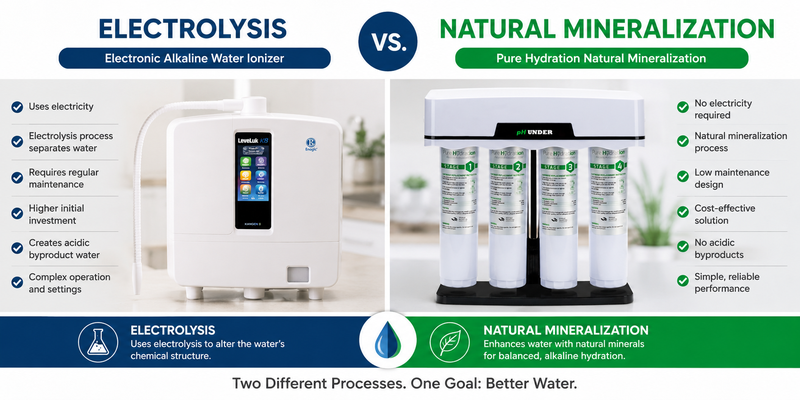
High-Voltage Electrolysis Natural Mineralization
Tap Water + 230W Current Tap Water + Active Minerals
Forced Electrical Split Natural Bio-Chemical Reaction
Unstable pH & Rapid Oxidation Bio-Available Ions & Stable pH
Electric Ionization (Kangen SD501)
Electric water ionizers like the Kangen SD501 use an electrolysis chamber equipped with platinum-coated titanium plates. Tap water passes over these plates while a high-voltage electrical current (up to 230 Watts) forces the water molecule to split into hydrogen and hydroxyl ions.
- Mechanism: Forced electrical splitting of tap water minerals.
- pH Stability: The resulting high pH (8.5 to 11.0+) is driven by temporary electrical charge rather than structural mineral buffering. Consequently, the pH and oxidation-reduction potential (ORP) decay rapidly when exposed to air, light, or ambient temperatures.
- Maintenance Overhead: High-voltage electrolysis causes dissolved calcium and magnesium to precipitate rapidly onto the titanium plates. This requires routine chemical scaling, acidic cleaning cartridges, and manual flushes to prevent performance degradation.
Natural Mineral Ionization (Pure Hydration)
Pure Hydration bypasses high-voltage electricity entirely, replicating how mountain spring water naturally acquires its vitality as it flows over mineral-rich rock strata.
- Mechanism: As purified water flows through the system’s specialized media, it interacts with high-purity elemental magnesium, calcium, potassium, and trace bioceramics.
- Chemical Reaction: The naturally occurring redox reaction between elemental magnesium and water yields pure dissolved hydrogen gas and natural hydroxide ions:
- pH Stability: This organic process yields an optimal biological pH between 9.0 and 9.5. Because the alkaline state is stabilized by bio-available mineral cations rather than an artificial electrical charge, the water retains its pH structure and antioxidant properties far longer.
- Molecular Hydrogen & Cellular Antioxidant Potential
In contemporary sports science and anti-aging research, the focus has shifted away from general “alkalinity” toward Molecular Hydrogen. As the smallest molecule in existence, diffuses rapidly across cell membranes, penetrating the blood-brain barrier and mitochondrial walls to selectively neutralize harmful hydroxyl free radicals .
ANTIOXIDANT MOLECULAR SIZE COMPARISON
Vitamin C: 176 Da
Vitamin E: 430 Da
CoQ10: 863 Da
Mol. H2: 2 Da <– Easily penetrates mitochondrial membranes
Measuring Antioxidant Yield
Molecular hydrogen concentration is quantified in parts per billion (PPB) or parts per million (PPM), where .
- Pure Hydration: Consistently generates 1,400 to 1,500 PPB of dissolved molecular hydrogen under normal household flow rates.
- Kangen SD501: Produces between 1,200 and 1,300 PPB when pristine and newly cleaned, though output drops significantly as mineral scale accumulates on the internal electrolysis plates.
By utilizing elemental magnesium media, Pure Hydration delivers equivalent or superior antioxidant potential without requiring high electrical wattage, transformers, or delicate platinum electrodes.
- Affordability, Sustainability, and True Ownership Cost
When evaluating value, consumers must look beyond initial acquisition costs to include ongoing maintenance, power consumption, and replacement components over a multi-year horizon.
The Multi-Level Marketing (MLM) Markup
The Kangen SD501 carries an average retail price around $4,000 to $5,000. This elevated cost is largely driven by Enagic’s direct-sales multi-level marketing distribution structure, where thousands of dollars per unit are allocated to multi-tier commission payouts rather than raw manufacturing inputs.
Direct-to-Consumer Efficiency
Pure Hydration operates on a direct distribution model, delivering its core system for $495. By eliminating MLM commission overhead, electronic circuit boards, touchscreens, and platinum plates, the technology focuses investment strictly where it impacts health: ultrafiltration quality and high-purity mineral media.
| Feature / Metric | Pure Hydration | Kangen SD501 |
| Primary Technology | Ultrafiltration + Natural Mineral Media | Standard Carbon + 7-Plate Electrolysis |
| Filtration Rating | 0.02 Micron (Ultrafiltration) | 3.0 Micron (Carbon Block) |
| Electricity Required | None (Gravity/Water Pressure) | Yes (Up to 230 Watts) |
| pH Range (Drinking Water) | 9.0 – 9.5 (Naturally Buffered) | 8.5 – 9.5 (Electrolytic Split) |
| Dissolved Hydrogen () | 1,400 – 1,500 PPB | 1,200 – 1,300 PPB |
| Plate Scaling Risk | Zero (No plates) | High (Requires routine citric acid wash) |
| Initial Purchase Price | $495 | ~$4,000 – $5,000 |
| Annual Maintenance Cost | Low (Cartridge replacements) | High (Filters, cleaning packs, deep cleans) |
Biological Hydration Guidelines: Optimizing Cellular Intake
Creating functional water is only half the equation; consuming it correctly maximizes metabolic absorption, cellular detoxification, and nutrient transit.
- Calculate Daily Water Target: Aim for approximately 50% of your body weight in fluid ounces daily. For an individual weighing 160 lbs, baseline intake should be 80 oz (approx. 2.4 liters) of pure water.
- Gradual Metabolic Adaptation: If transitioning from acidic tap or bottled water, begin with 24–32 oz of natural 9.0–9.5 pH water per day for week one, increasing gradually to allow gastrointestinal flora to adjust.
- Optimal Timing for Digestion: Consume functional hydrogen water on an empty stomach—30 minutes before meals or two hours after. Avoid drinking large volumes of high-pH water during meals to ensure stomach acid () maintains its natural digestive pH.
- Drink Fresh for Peak Potential: Dissolved hydrogen gas escapes over time. To receive the maximum antioxidant yield (1,500 PPB), drink freshly drawn water directly from the system or store it in airtight, double-walled stainless steel containers.
The Verdict: Biomimicry Beats Artificial Current
When evaluated side-by-side on filtration precision, hydrogen concentration, pH stability, and long-term value, the advantage shifts decisively toward natural mineral transformation.
While the Kangen SD501 remains a recognized pioneer in early electronic ionization, its 3.0-micron filtration and high-voltage electrolysis carry unnecessary complexity, high maintenance demands, and an inflated price tag. Pure Hydration demonstrates that by honoring nature’s process—combining 0.02-micron ultrafiltration with active elemental minerals—you achieve superior water quality, bioavailable molecular hydrogen, and pure hydration at a fraction of the cost.